
Can a tattoo be covered up? Usually, yes. A cover-up tattoo is new ink designed to hide an old one, and how well it works depends on a few things you can check yourself. This guide is about ink over ink, not makeup. It covers what makes an old tattoo easy or hard to hide, which colors and designs do the work, and what to send your artist.
What Counts as a Cover-Up Tattoo?
How to cover up a tattoo with another tattoo sounds simple: put new ink on top. In practice, the new piece has to do the hiding, so it gets planned around whatever’s already in your skin.
Sometimes the old tattoo disappears completely. Other times its lines get folded into the new picture, so a stray outline turns into a branch or a wave. Both count as a cover-up.
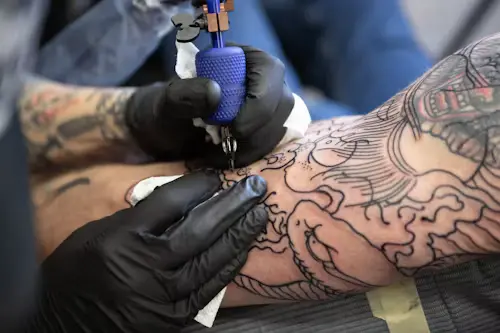
What Makes an Old Tattoo Easy or Hard to Cover
Before you start collecting cover-up tattoo ideas, look at the old tattoo, not the new one. It decides most of what’s possible.
Darkness is the big one. A faint, faded piece barely fights back, while dense black does. How packed the ink is matters just as much: thin lines leave plenty of untouched skin for new ink to work with, and thick lines and solid fills don’t.
Size comes next. A small mark gives you far more room to play than a wide dark band. Placement counts too, since skin that moves a lot, like a hand or an elbow, changes what holds up.
Then there’s age. Old ink doesn’t stay put. University of Pittsburgh immunologists explain that immune cells called macrophages are responsible both for letting ink show up and for fading it over time. That’s why a ten-year-old tattoo is often softer than it was on day one. Softer is friendlier to cover.
Last, there’s how loud the old design is. A crisp, high-contrast piece shows through more than a blurry one, even at the same size.
What Tattoos Can Be Covered Up
Picture the easy end. A small symbol that’s gone gray. Script that’s blurred at the edges. Something thin-lined and light from years ago. Most of these give an artist plenty of options, and a few can be hidden with something simple.
Easy doesn’t mean careless, though. A small old tattoo can still call for a bigger, darker new one than you’d expect.
What Tattoos Can’t Be Covered Up (and What Happens Then)
Almost nothing is flatly impossible. But plenty of old tattoos can’t be hidden by the particular design you’re picturing. A large, dense black piece under a pale, delicate flower is the classic example.
When it happens, a good artist doesn’t just say no. They’ll usually suggest something bigger, darker, or busier, or a different idea altogether, or they’ll tell you plainly that the one you love won’t hide what’s there. Be wary of anyone who promises the old tattoo will vanish before they’ve seen it. Nobody can promise that from a text message.
Can You Tattoo Over Black Ink?
Yes, you can. The new tattoo just has to be dark enough, and usually big enough, to win. Black over black is the simplest match. Deep colors like navy, forest green, dark brown, and dark purple can work too, especially when they’re packed in with heavy shading.
What usually doesn’t work is pale or bright ink laid over fresh, solid black. Yellow, light pink, and white sit softer in the skin, so the black underneath tends to show through. An old, faded black piece is a different story and can be more forgiving, which is one more reason age matters.
What Colors Cover Old Tattoos
The rule fits in one line: dark hides light, and light doesn’t hide dark.
So the colors artists reach for most are black, deep blue, brown, green, and rich purple. Bright yellow, orange, and pastel shades are the risky ones. Think of paint. A dark color covers a pale wall in one coat, but a dark wall bleeds through a pale one.
Most cover-ups use both. Dark shading and heavy line do the hiding, and brighter color goes on top for interest.
Which Designs Hide Old Ink Best
With cover-up tattoo designs, shape matters more than subject.
Organic, uneven shapes hide old ink well. Think flowers and leaves, feathers and fur, waves, smoke, clouds. Nobody can say where a petal should end, so a stray old line slips right into the picture. Add texture and a mix of dark and light areas, and the eye lands on the new work instead of the old.
Symmetrical, precise designs are harder. A mandala, perfect geometry, or crisp lettering gives the eye a pattern to check, and one old line poking through breaks it. That doesn’t put those styles off limits. It just means the old tattoo has to be very light, or very well covered underneath.
Why the New Tattoo Is Usually Bigger
Artists often size a cover-up up. A larger design can extend past the edges of the old tattoo, where there’s nothing to hide, and it has room for dark and light areas that pull the eye away.
It isn’t a hard rule. A small, faded piece can sometimes sit under something about the same size, especially a simple flash design. Your artist will tell you which situation you’re in once they’ve seen it.
How Long After a Tattoo Can I Get It Covered Up?
Wait until the old tattoo has fully healed. Healthline notes that the surface can look healed within a few weeks, while the full process takes much longer, so “looks fine” and “ready” aren’t the same thing. If you’re not sure where yours stands, our guide to what each week of healing looks like shows what’s normal.
And if you just got a tattoo you regret, you don’t have to rush. Time often softens ink, and your artist can tell you whether waiting makes sense.
How to Photograph Your Old Tattoo
Every conversation about how to cover up an old tattoo with new design work starts the same way: a clear look at what’s there.
Shoot in daylight, with no filter and no flash glare. Take one straight-on shot and a couple from the sides, with the skin relaxed. Put a coin or a ruler beside it for scale, and mention the real size. Include any scars or other tattoos nearby. If one part of the old tattoo bothers you more than the rest, point it out.
The design work and stencil check come after that, and they run like any other custom piece. Our walkthrough of the drawing and stencil steps covers them in full.
Rework Instead of a Full Cover
You don’t always need to hide everything. Sometimes the old tattoo has a line or shape worth keeping, and the new design builds around it. That can be easier than a total cover, because the artist isn’t fighting every old line, and it tends to look more intentional too.
Choose an Artist Who Does Cover-Ups
Not every artist enjoys cover-ups, and not every style suits them. Look for finished cover-ups in a portfolio, not just fresh work, and ask how they’d handle your piece. A gorgeous design with no old ink under it tells you less. Our guide to finding an artist whose work fits your idea goes through what to look for.
Our artists at the Concord Pike studio look at your old tattoo before anything gets drawn, and tell you straight what will and won’t hide it.
Start Your Cover-Up at Concord Pike
Send photos or stop by 1707 Concord Pike in Wilmington, DE. An artist at Tainted Flesh Body Art North will look at your old tattoo and give you an honest read on what can hide it. See how we handle cover-up work at our Concord Pike studio, then book a consultation when you’re ready
Frequently Asked Questions About Tattoo Cover-Up Guide
Not reliably. White ink sits lightly in the skin, so black underneath tends to show through. Most artists use white for small highlights on top of a design, not as the cover itself.
Sometimes. If the old piece is small and faded, a design of similar size can work, especially a simple flash piece. If the old one is dark, the new one usually needs to be darker and larger to hide it.
Yes, and it’s a common request. Letters are mostly thin lines with gaps between them, which gives an artist room to work. Organic shapes like flowers, leaves, or waves tend to hide text better than anything symmetrical. Bold, dark script is a tougher case, so send a clear photo.
You can, and some artists are glad to rework their own tattoos. Ask whether their current style suits cover-ups, since not every artist does that work well. Whoever you pick, the old tattoo should be fully healed first.
On its own, rarely. Thin lines leave a lot of open skin, so the old ink shows through. Fine line works better as a finishing layer, sharpening edges and adding detail after something heavier has done the hiding.
They can, but they’re harder. A mandala or a perfect pattern shows any old line that pokes through. If you love the style, say so, and your artist will tell you whether your old piece allows it.
You can bring any idea. The question is whether it hides the old tattoo. A pale or delicate design over dark ink won’t, but your artist can often adjust it with darker shading, a larger size, or a different arrangement of the elements.
Often, yes. Soft, uneven, or faded work usually gives an artist more room than crisp, dense work. What matters is how dark and packed the ink is, not how well the original was done. Send photos and ask for an honest opinion before you commit.
Sometimes, but the options narrow. Each layer adds more ink to hide, so the next design has to be bigger and darker. Your artist will say whether a second cover is realistic.
Give a direction, not a rulebook. Say what you love, what you can’t stand, and what matters most. If you lock in the subject, the color, and the exact size, there may be no way to hide the old ink. A little flexibility usually gets a better result.